Apple barrel
The apple barrel aboard the Hispaniola is a seemingly ordinary shipboard fixture—a barrel of apples kept broached in the waist for any crewman to help himself. Yet it becomes the pivotal object of Treasure Island, the accidental hiding place from which Jim Hawkins overhears Long John Silver's mutinous council and learns the true nature of the voyage. This single moment of concealment, born of a boy's craving for an apple, exposes the conspiracy that threatens the lives of every honest man aboard and redirects the entire course of the adventure.
The Barrel and Its Place on the Ship
The apple barrel was part of the generous provisioning that made the Hispaniola's crew, in Jim's words, "a ship's company so spoiled since Noah put to sea." Double grog was issued on the least excuse, duff appeared on odd days, and a barrel of apples stood always open in the waist for anyone with a fancy. Captain Smollett, ever wary, warned that such indulgence would "spoil forecastle hands, make devils," but the captain's suspicion was aimed at the crew's morale, not at the barrel itself. The barrel was, in fact, a deliberate indulgence by Squire Trelawney, who had spared no expense in fitting out the schooner. Its presence in the waist, between the forecastle and the quarterdeck, made it a natural gathering spot, and its open top invited casual use. Jim, who had been sent to the galley by the captain to keep him out of the way, found the barrel an irresistible temptation on the evening before the island was sighted.
The Night of Revelation
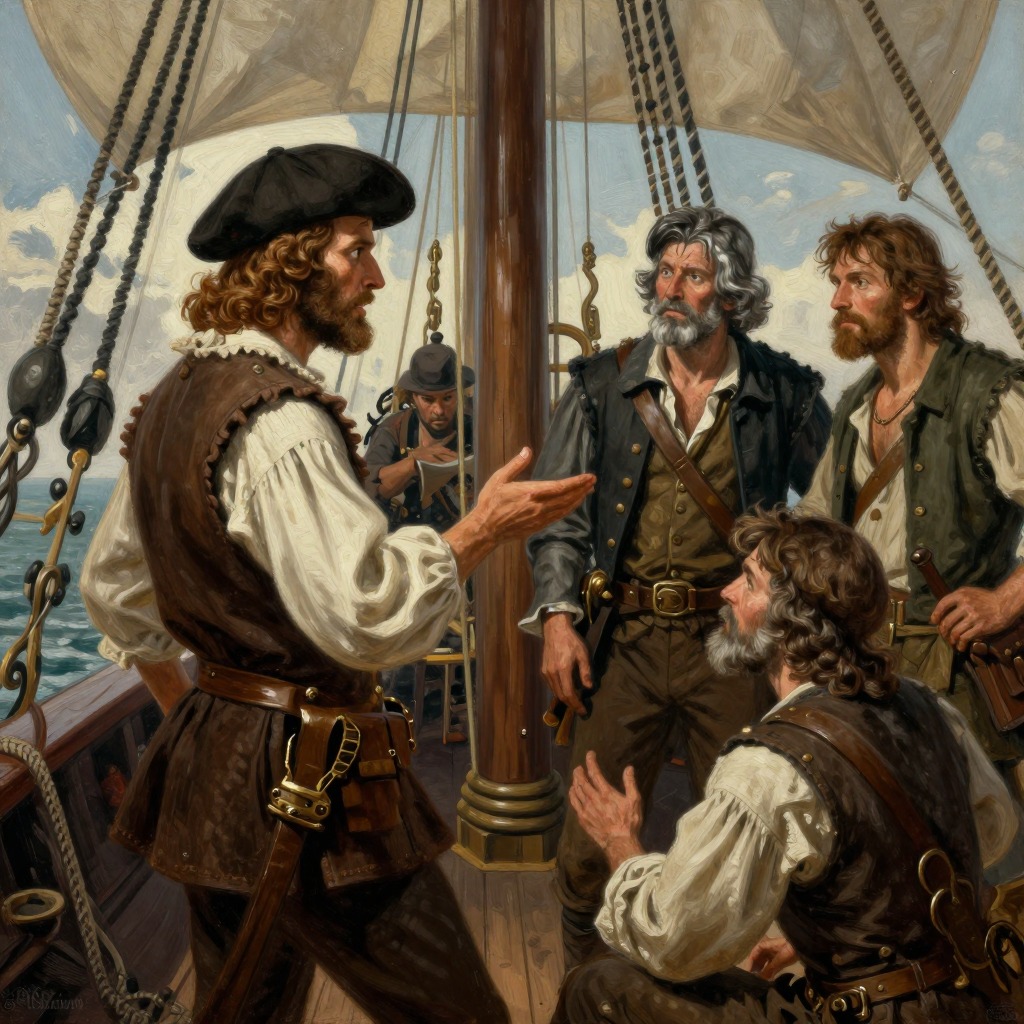
On the last day of the outward voyage, just after sundown, Jim finished his work and decided to take an apple. The watch was forward, the helmsman was whistling, and the sea was quiet. Jim climbed bodily into the barrel, finding scarce an apple left, and sat down in the dark. The rocking of the ship and the sound of the waters soon had him on the point of sleep when a heavy man sat down with a clash close by, leaning his shoulders against the barrel. It was Silver's voice, and before Jim had heard a dozen words, he understood that "the lives of all the honest men aboard depended upon me alone." He lay trembling, listening in "the extreme of fear and curiosity," as Silver revealed the plot to the young seaman Dick and the coxswain Israel Hands. The conversation, which Jim later recounted in full to the captain, squire, and doctor, laid bare the mutiny: Silver was the ringleader, the crew were pirates, and they intended to seize the treasure and kill the honest men. Jim heard Silver's cynical philosophy of "gentlemen of fortune," his plan to let the squire and doctor find the treasure and then "finish with 'em at the island," and his chilling vote for death: "I give my vote--death." He also heard Israel Hands's remark that "not another man of them'll jine," revealing that some hands remained faithful.
The barrel's concealment was nearly betrayed when Silver, thirsty, asked Dick to fetch him an apple. Jim's terror peaked as he heard Dick begin to rise, but Hands intervened, demanding rum instead, and the moment passed. The moon rose, silvering the mizzen-top, and the lookout's cry of "Land ho!" broke up the council. Jim slipped out of the barrel, dived behind the fore-sail, and joined the rush to the weather bow, carrying his terrible knowledge with him.
The Barrel's Legacy
The apple barrel's significance extends beyond the single night of eavesdropping. It was, as the captain later noted, the source of the warning that saved them all: "if it had not been for that, we should have had no note of warning and might all have perished by the hand of treachery." The information Jim gathered allowed the loyal party to prepare, to arm themselves, and to plan their defense. It also gave Jim a secret power, one he would wield again in the enemy's camp when he confronted Silver and the mutineers, declaring, "I was in the apple barrel the night we sighted land, and I heard you, John, and you, Dick Johnson, and Hands, who is now at the bottom of the sea, and told every word you said before the hour was out." The barrel thus became a symbol of the boy's accidental heroism, the humble object that turned a cabin boy into the savior of the expedition.
In the broader narrative, the apple barrel exemplifies how Stevenson invests ordinary objects with dramatic force. Like the sea-chest, the black spot, and the treasure map, the barrel is a thing that carries the plot forward through its material presence. It is a listening post, a hiding place, and a witness to treachery, and its role in the story underscores the theme of hidden knowledge and the precariousness of trust. The barrel's apples, meant for the crew's comfort, became the bait that lured Jim into the heart of the conspiracy, and the barrel itself, a simple wooden cask, proved more valuable than any of the ship's stores in the fight for survival.